Like a dandelion through asphalt – Growing through resistance
Oliver Omondi, founder and CEO of Zuripacks, grew up in Kibera, Africa’s largest urban informal settlement. There, plastic waste was not an abstract environmental issue but a daily reality, clogging drainage systems, contaminating public spaces, and harming public health through open-air burning. Witnessing the devastating effects of plastic pollution in an underserved community without proper waste management infrastructure deeply frustrated Oliver. He saw how heavily everyday life depended on plastic-based packaging and how this dependence fueled an uncontrollable waste problem. Even though he believed solutions could be found within local resources. He refused to accept these conditions as inevitable.
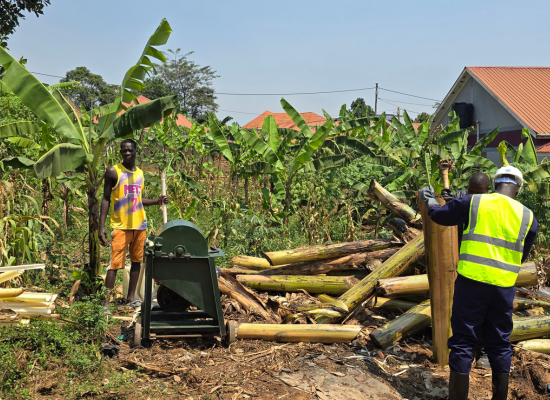
A turning point came when Oliver began exploring the science behind materials and realised that chemistry plays a central role in how everyday products are designed, produced, and disposed of. He learned that the plastic packaging crisis is fundamentally a materials and chemistry problem, driven by fossil-based polymers that persist in the environment. At the same time, he observed that banana pseudostems in rural areas were treated as waste and discarded in large quantities, despite being rich in natural fibers.
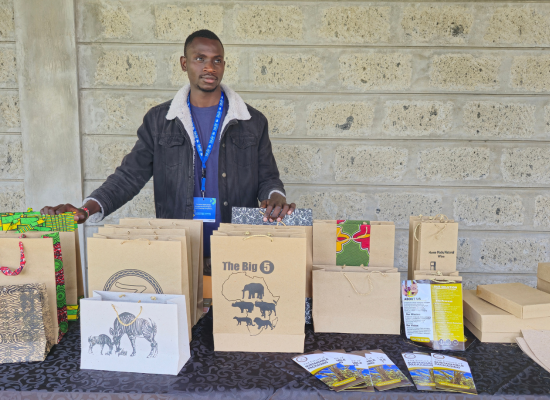
Connecting these insights sparked the idea for Zuripacks. Sustainable Chemistry offered a framework for designing materials that are renewable, biodegradable, and non-toxic by intention. In 2022, Oliver assembled an interdisciplinary team that began experimenting with extracting fibre from banana pseudostems and processing it into tree-free paper, which helped the idea take root. This material was then molded into plant-based, biodegradable packaging as a sustainable alternative to plastic. What started as small-scale experimentation has since evolved into a growing enterprise that transforms agricultural waste into packaging materials while creating income opportunities for farmers, women, and youth in underserved communities.
“Zuripacks was born at the intersection of lived experience, environmental urgency, and the realisation that Sustainable Chemistry can be a powerful tool for climate and social transformation"
, Oliver explains.As founder and CEO, Oliver brings expertise in business and finance. He is a qualified Certified Public Accountant (CPA) and has experience in entrepreneurship and innovation, with a focus on climate solutions and circular economy models. Over time, he has developed hands-on expertise in biomaterials research, particularly in extracting and processing natural fibres into biodegradable, paper-based packaging derived from agricultural waste.
Zuripacks is supported by a multidisciplinary core team combining technical, operational, and business expertise. CTO Amos Nyasani holds a BSc in Materials and Process Engineering and leads product development, materials processing, and quality control. COO Felix Lagat holds a diploma in Operations and Supply Chain Management, with training in production management, and oversees efficient, safe, and reliable production systems. The leadership team currently consists of three executives, supported by two technical advisors and sixteen production team members, many of whom are trained women and youth from underserved communities.
Like many early-stage material innovations, Zuripacks has faced significant challenges. One major hurdle has been access to efficient processing machinery. Producing bio-based packaging requires specialized equipment, and limited access to capital has slowed the company’s ability to scale production. Market adoption has also been challenging, as many businesses remain price-sensitive and accustomed to conventional plastic packaging. Encouraging customers to switch to sustainable alternatives requires ongoing education, testing, and clear demonstrations of performance and cost competitiveness.
The team has also encountered technical challenges in optimizing fibre extraction and ensuring consistent material quality at scale. Transforming agricultural waste into high-performance packaging demands continuous experimentation, process refinement, and quality control. Despite these obstacles and an environment that was anything but fertile, each challenge has strengthened the company’s model, improved its processes, and reinforced its commitment to building a scalable, circular, and sustainable packaging solution.
The name Zuripacks comes from the Swahili word “zuri,” meaning “good,” combined with “packs,” short for packaging. It reflects the company’s vision of creating packaging that is not only functional, but also environmentally and socially beneficial.
“For us, ‘zuri’ represents clean environments, dignified livelihoods, and circular solutions that restore rather than pollute,” Oliver says. “‘Packs’ reflects our focus on sustainable packaging innovation. Together, Zuripacks embodies our mission to redesign packaging systems in a way that is both environmentally responsible and socially empowering"
, explains Oliver.Like a dandelion pushing through asphalt, Zuripacks proves that resilience, when nurtured, will always find a way to grow.
Sustainability made to last
The innovation driving Zuripacks lies in transforming banana pseudostems, an underutilised agricultural by-product, into plant-based, biodegradable packaging materials through a resource-efficient fibre extraction and moulding process.
Zuripacks’ technology begins with the mechanical extraction of natural fibres from banana pseudostems. These fibres are then processed using controlled pulping and sheet-forming techniques to produce tree-free paper, which is subsequently moulded and pressed into packaging products designed to replace single-use plastic packaging. Throughout the process, the team prioritises low-toxicity additives such as wood ash and cassava starch, alongside water efficiency and process optimisation. This ensures environmental safety and scalability while promoting circular economy principles by converting agricultural waste into high-value materials.
The core innovation lies not only in the use of agricultural waste as a raw material, but also in the engineering of fibre structures and processing conditions to achieve strength, durability, and functional performance comparable to conventional packaging materials.
Unlike plastic-based packaging, Zuripacks’ products are biodegradable and derived from agricultural waste rather than fossil-based materials, helping to reduce plastic pollution and greenhouse gas emissions. The biodegradability was tested with National Environment Management Authority (NEMA). Additionally, compared to traditional paper packaging, they are tree-free, thereby contributing to reducing deforestation associated with paper production.
Beyond environmental benefits, the innovation delivers significant social and economic value. By sourcing banana pseudostems, Zuripacks creates additional income opportunities for smallholder banana farmers. The company also provides sustainable livelihoods for women and youth trained in production, strengthening local value chains. Through skills development, workforce inclusion, and capacity building, Zuripacks empowers underserved communities and promotes equity and resilience. As a result of this engagement, the team is already seeing positive changes in their environment, harvesting the fruit of their labour. So far, the company has replaced 3.2 million pieces of single-use plastic packaging, has repurposed up to 10,900 tonnes of banana pseudostems by partnering with more than 350 farmers and has trained and empowered over 300 women and youth. This has consequently resulted in cumulative mitigation estimate of up to 6,000 tonnes CO₂ emissions to date.
“By combining materials science, Sustainable Chemistry principles, and circular economy thinking, we create packaging that is renewable, biodegradable, and socially inclusive”
, explains Oliver. Next up at Zuripacks
Currently, the team is focused on scaling production and strengthening the technical feasibility of their plant-based, biodegradable packaging. This includes optimising fibre extraction, refining material quality, and improving process efficiency to ensure consistent, high-performance products. They are also expanding the production team, providing skills training to women and youth, and building reliable supply chains for banana pseudostems. At the same time, the start-up is driving market adoption by engaging businesses to transition from plastic to sustainable packaging.
Looking ahead, Zuripacks aims to scale its impact by increasing production capacity, expanding product lines, and enhancing material performance while maintaining full biodegradability. The company also plans to strengthen partnerships, reach international customers, and attract investment to support long-term growth.
With their innovative approach, Zuripacks, who joined the ISC3 Global Start-up Service in January 2026, actively contributes to SDG8 (Decent Work and Economic Growth), SDG12 (Responsible Consumption and Production), SDG13 (Climate Action).