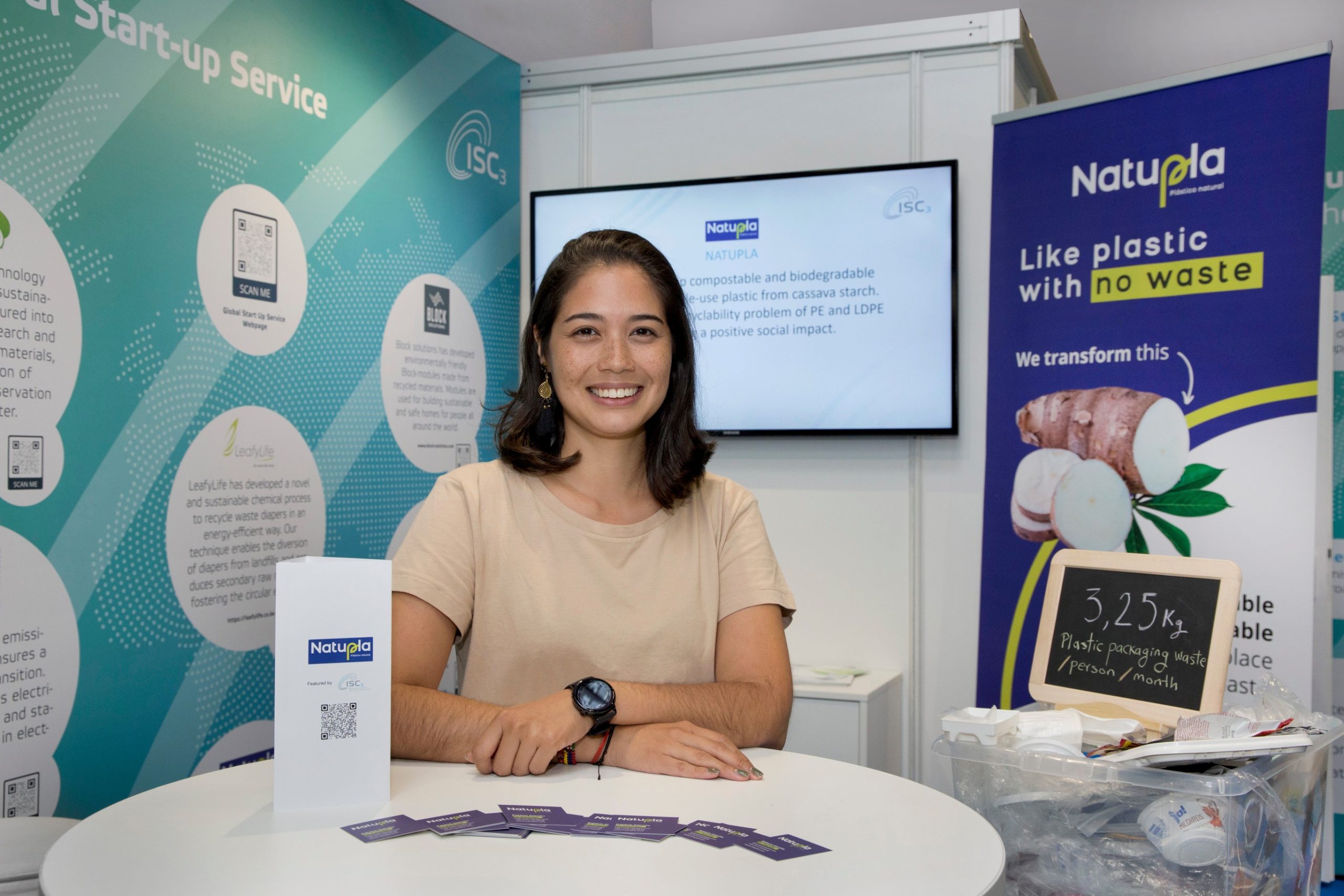
The driving forces behind Natupla
Creating alternatives to plastics that are just as competitive, high-performance, versatile, and cost-effective, yet fully biodegradable – that is the goal the two founders have set for themselves. By doing so, they are addressing one of the most pressing environmental issues of our time. For more than five years, the Carrillos have been experimenting with their idea, which was originally sparked by their rejection of single-use plastics in their personal lives. The family-owned business initially focused on bio-based polymers for arts and crafts. Then they began to consider how they could use their expertise in starch-based polymers to replace single-use plastics. Katerin Carrillo and her father Ramon began developing a business model for producing packaging materials from locally sourced starch. Nearly four years after being recognised as Start-up of the Month, we spoke with Natupla about their progress, experiences, milestones, and the support they’ve received from the ISC3 Global Start-up Service.
What does Sustainable Chemistry mean to you?
Sustainable Chemistry is our “North star” for everything we do at Natupla. It is not just a part of our process, but the foundation of our entire business model. Because the concept of Sustainable Chemistry is leading the industry away from the retroactive reduction of environmental pollution toward a new way of thinking. The goal must be to bring only products to market that do not burden the environment in the first place. We align our business activities with the ISC3 Key Characteristics for Sustainable Chemistry. This ensures that we actively contribute to the circular economy.
We use renewable local feedstock to reduce our dependence on fossil fuels. We also avoid hazardous substances to ensure that our compounding process is safe for both our employees and the environment. From the very first step of the design process, we consider the entire lifecycle of our product — ensuring it can be fully returned to the nutrient cycle with biodegradability at its core.
Where do you stand today compared to when you were named “Startup of the Month”?
What began as a laboratory application has now become a market-ready product. We are currently expanding our production capacity to 20 tons per month. Our working conditions have also improved significantly. The core team consists of three experts working in a well-equipped laboratory, where we are vigorously driving the further development of our technology.
How have you benefited from the collaboration with ISC3 and the support provided by the ISC3 Global Start-up Service?
The ISC3 Global Start-up Service has been invaluable to us. Participating in the ISC3 programmes opened doors for us to key contacts in Germany and potential partners around the world. The networking was also crucial for understanding how we need to position our technology to meet international standards. In addition, it gave us a better overview of the global market. This was crucial for assessing technology trends and regulatory changes outside of Latin America. Having ISC3 experts at hand who grasp both the chemistry and the business side made a real difference — helping Natupla strike the right balance and sharpen its scaling strategy.
What have been the highlights of your journey so far?
The most significant milestone was our compostability pilot project in collaboration with GIZ, Acoplasticos, and ICIPC (Institute for Training and Research on Plastics and Rubber). It proved that our materials are compostable on both laboratory and pilot scale.
What does all this mean for your company?
Our progression is gaining public recognition. That’s very motivating. Our international profile was significantly boosted by a radio report on Deutsche Welle (DW) that highlighted our efforts to address the plastic crisis in Colombia. Additionally, being named ISC3 Startup of the Month has given us greater visibility in the market. Today, Natupla is supported by funding from the Colombian Ministry of Science and La Asociación Nacional de Empresarios de Colombia (ANDI).