A Seed Planted Against Deforestation
Ecovon was founded in 2018, insipred by a direct encounter with the environmental consequences of unsustainable building material production. Brenya Isaac, Co-Founder and CEO of Ecovon, holds a BSc in Urban Planning from the University for Development Studies in Ghana. During his final year, he frequently travelled to southern Ghana, where he witnessed severe deforestation driven largely by timber logging for conventional medium-density fibreboard (MDF) production. He saw how forest loss was not only degrading ecosystems, but also disrupting rainfall patterns, agriculture, and rural livelihoods.
“I asked myself whether building materials had to come at the expense of nature”
, Brenya recalls.This question became a turning point. Brenya began exploring how principles of Sustainable Chemistry — particularly green material innovation and circular resource use — could replace wood-based inputs with renewable agricultural residues such as coconut husk and bagasse. Ecovon emerged as a response to this challenge: transforming underutilised bio-waste into high-performance, binderless boards that offer a circular, climate-friendly alternative to traditional MDF while protecting forests and supporting resilient communities.
Today, Ecovon is led by a complementary, execution-focused team of four, combining business leadership, engineering, finance, and operations expertise. In addition to his undergraduate degree, Brenya holds a Leadership in Business Certificate from Lehigh University (USA) and a Master of Business Creation from the University of Utah (USA). He brings experience in venture building and strategic management. Alex Obeng, Technical Head, is a Mechanical Engineer with great experience in machine operations and maintenance. Michael Obanah, Finance Head, brings financial management experience and Foster Osei, Co-Founder and Operations Head, supports the team with his vast operational knowledge.Together, the team has the required skills to bring Ecovon from pilot validation to scalable industrial production.
“As citizens of Ghana, one of the world's largest producers of coconut, we became the change we wanted to see”
, explains Brenya.One of the company’s key challenges has been securing catalytic funding to bridge the gap between pilot validation and full-scale industrial production. As a capital-intensive manufacturing venture, scaling requires significant upfront investment in specialised machinery and production infrastructure. In addition, technical support for machinery design, customisation, and optimisation has been essential. Producing binderless boards from agricultural residues demands tailored equipment and advanced process engineering, which in turn requires both expertise and strong technical partnerships. Securing early-stage catalytic capital and advanced machinery support therefore remains central to accelerating Ecovon’s scale-up and market expansion.
The name Ecovon combines the words “eco-friendly” and “innovation,” reflecting the company’s mission to develop more sustainable materials for construction and everyday building applications, while rethinking how these products are made.
From Nature, Back to Nature
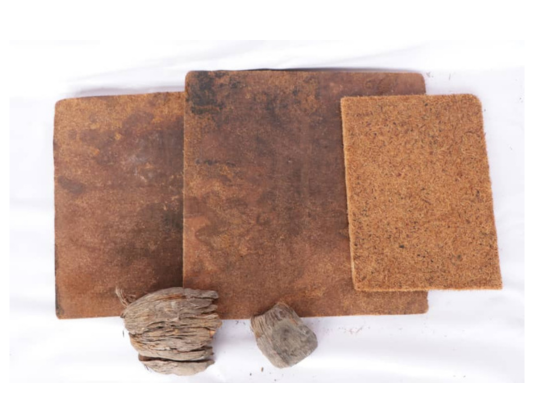
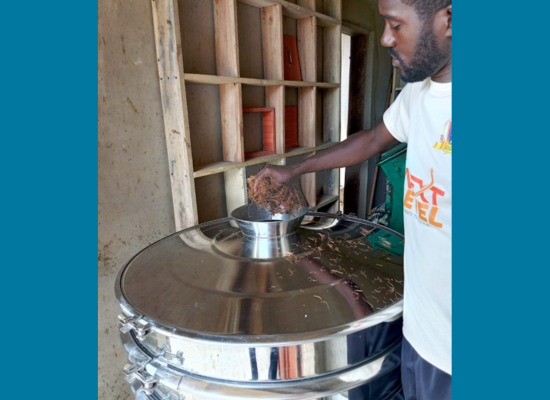
Ecovon’s core innovation lies in transforming agricultural waste such as coconut husks, sugarcane bagasse, and other bio-residues into high-performance, binderless boards that serve as a sustainable alternative to conventional MDF. The latter is widely used for interior panelling and furniture.
Traditionally, MDF is produced by breaking down wood into fine fibres, which are then mixed with synthetic binders and additives — often formaldehyde-based resins — to hold the fibres together. This mixture is pressed under high heat and pressure, forming dense, flat panels with a smooth and uniform surface. One of MDF’s main advantages is its workability: it can be cut cleanly and holds screws and nails well, making it a popular choice for furniture manufacturing. Ecovon rethinks this process from the ground up.
"Ecovon’s innovation is more sustainable than conventional MDF because it eliminates two major environmental challenges: deforestation and toxic synthetic binders"
, elaborates Brenya. Instead of timber, Ecovon valorises agricultural residues such as coconut husks. Rather than relying on added chemical adhesives, the company uses a proprietary thermo-mechanical process that activates the biomass’s own natural binding components — cellulose, hemicellulose, and lignin. Under controlled heat and pressure, these components bond internally, removing the need for synthetic resins altogether.The result is a durable board that retains essential performance characteristics while being designed to be biodegradable at the end of its life cycle. As part of their scale-up and market entry strategy, Ecovon is currently pursuing relevant certifications to formally validate the board's biodegradability and flame-retardant properties. By eliminating formaldehyde-based adhesives, Ecovon also reduces toxic emissions and improves indoor air quality, while significantly lowering pressure on forests.
By diverting biomass waste from open burning, reducing embodied carbon, and replacing wood-based panels, Ecovon advances a circular economy model that turns waste into value. Combining green chemistry principles with circular design, the company offers a climate-friendly and resource-efficient alternative to conventional MDF.
Beyond environmental benefits, the innovation also generates economic and social value. It creates local employment in waste collection, processing, and manufacturing, and turns previously discarded agricultural residues into a source of income. At the same time, it supports communities by protecting forest-dependent livelihoods and promoting healthier living environments.
Next up at Ecovon
Ecovon is currently focused on scaling production from pilot to industrial level, securing catalytic funding, and optimising machinery and processes to ensure consistent, high-quality binderless boards. At the same time, the company is strengthening strategic partnerships, and validating its solution with key customers to accelerate growth.The next major milestone is the transition from pilot production to a first commercial plant, enabling Ecovon to meet growing demand. Alongside scaling operations, the team aims to expand market reach, reinforce supply chains, and further enhance production efficiency and sustainability performance.
With their innovative approach, Ecovon, who joined the ISC3 Global Start-up Service in February 2020, actively contributes to SDG11 (Sustainable Cities and Communities), SDG12 (Responsible Consumption and Production), SDG13 (Climate Action), SDG15 (Life on Land).